
Your neighbour's tree is overhanging your yard: what Queensland law lets you do
By Trisim Property Maintenance, CairnsLast reviewed
- 11 min read
- 8 sources checked
- 7 questions answered
Yes: you can cut overhanging branches and roots to your boundary yourself, unless the tree is protected or near power lines. For branches 2.5m or lower reaching at least 50cm over, a Form 3 notice gives the tree-keeper at least 30 days; if they ignore it, you can recover reasonable costs up to $300 after a Form 3 notice.
Fruit on the lawn, branches over the fence, roots under the path: trees are a very common cause of disputes between neighbours. Queensland has a specific law for it, the Neighbourhood Disputes (Dividing Fences and Trees) Act 2011.
This guide covers what you can cut yourself, the Form 3 notice, the Queensland Civil and Administrative Tribunal (QCAT), protected trees and power lines, and clearing the green waste afterwards; it is general information, not legal advice.
Quick answers: overhanging trees in Queensland
- Cut back to the boundary yourself: yes, for branches and roots, under the common law right of abatement.
- Formal notice: a Form 3 notice gives the tree-keeper at least 30 days, for branches 2.5m or lower reaching at least 50cm over.
- Cost cap: reasonable costs up to $300, and only for work done after a Form 3 notice.
- Higher branches: more than 2.5m up and overhanging by at least 0.5m, apply to QCAT.
- Leaves and fruit: normal tree litter is usually not enough for a QCAT order.
- Before anyone cuts: check for a vegetation protection order and keep clear of power lines.
Can you cut a neighbour's overhanging branches in Queensland?
You can cut overhanging branches back to your boundary line yourself. The Queensland Government's tree dispute page calls this the common law right of abatement: your right to remove overhanging branches and roots to your boundary line. The Act keeps that right in place in section 54.
The right has limits:
- Stop at the boundary: the right covers what overhangs your land, not the rest of the tree.
- Check protection first: the Queensland Government says to take care to comply with any applicable tree or vegetation protection orders when you trim.
In most cases the tree-keeper is the registered owner of the land the tree grows on, and it is not just individuals: a tree-keeper could be an organisation or a body corporate. A friendly word before you start is still worth it.
How do you get your neighbour to remove the branches?
If you would rather the tree-keeper did the work, Part 4 of the Neighbourhood Disputes (Dividing Fences and Trees) Act 2011 sets out a formal process. Talk face to face first; if that does not work, these are the steps.
- 1Check the branches qualify. Section 57 of the Act says the notice covers branches that reach at least 50cm over your side of the boundary, and only the parts that are 2.5m or less above the ground.
- 2Get at least one written quote, then fill in Form 3, Notice for removal of particular overhanging branches. Give a date at least 30 days away, ask to be told in writing who will do the work and when, allow the tree-keeper or their contractor onto your land that day between 8am and 5pm, and attach a copy of Part 4 of the Act.
- 3If the branches are still there after the date, cut and remove them yourself or have someone else do it. Section 58 of the Act makes the tree-keeper liable for reasonable expenses up to $300.
- 4If they do not pay, QCAT says you can apply to recover it as a minor debt dispute.
Section 57 of the Act says you can only give one of these notices to the same tree-keeper in any 12 months, so list every qualifying branch, across one or more trees, in the one notice.
What to have ready before you give the notice:
- Photos of the overhang: show how far the branches reach over the boundary and how high they are, since the 50cm and 2.5m tests decide whether the notice applies.
- A written quote: the Act needs at least one with the notice.
- A copy of Part 4 of the Act: it goes with the notice.
- Dates of contact: note when you spoke to the tree-keeper and what was agreed, in writing, because QCAT looks for a reasonable effort to reach agreement first.
What if the branches are higher than 2.5m?
Branches more than 2.5m above the ground sit outside the Form 3 notice. Where they overhang by at least 0.5m, the Queensland Government says you can apply to QCAT for an order.
QCAT's tree dispute page says it may make an order if satisfied you first made a reasonable effort to reach agreement with the tree-keeper, and that removal of a tree will only be ordered if no other satisfactory outcome can be achieved.
What about roots, leaves and danger to your property?
These also go to QCAT rather than the notice process.
- Roots: cut invading roots back to the boundary under the abatement right. For damage already done, QCAT orders can include compensation or repair costs for damage to your property.
- Leaves, flowers and fruit: normal tree litter is usually not enough for an order to remove or cut back a tree. A substantial and ongoing accumulation of tree litter in your yard can count as unreasonable interference.
- Danger: a tree legally affects your land if, in the next 12 months, it is likely to seriously injure someone there, seriously damage your land or property, or cause substantial, ongoing and unreasonable interference with your use and enjoyment of it.
Once QCAT makes an order, section 77 of the Act sets a maximum penalty of 1,000 penalty units for a person who fails to comply with a requirement of the order without a reasonable excuse.
Should you try mediation before QCAT?
Mediation is the step between a stalled conversation and a tribunal application. The Queensland Government says Dispute Resolution Centres are based in Brisbane, Hervey Bay, Rockhampton, Mackay, Townsville and Cairns, and that neighbourhood mediation is cheaper, easier and quicker than taking legal action, and in many cases free. QCAT's overhanging branch page also suggests contacting a Dispute Resolution Centre to discuss free mediation before you take any legal action.
Mediation is voluntary, so the other side has to agree to take part. When you reach an agreement, over the fence or in mediation, the Queensland Government's advice is to get it in writing.
Where to get advice
For advice on your own case, the Queensland Government's step-by-step guide to tree and fence disputes points to a community legal centre or a private lawyer, and notes that Legal Aid Queensland cannot give legal advice about tree and fence disputes.
Is the tree protected, or near power lines?
Two things can limit the right to trim: a protection order on the tree, and a power line near it. The Act says that, unless it expressly provides otherwise, it does not affect the operation of another Act or law, and it names the Electricity Act 1994 and the Vegetation Management Act 1999 as laws that also contain provisions about trees.
- Protected vegetation: QCAT's overhanging branch page says a property may have protected vegetation if it is near a waterway, in bushland, has heritage values, or contains large significant trees even in an urban area. Ask the local council. The Australian Government's business licence listing for Cairns Regional Council says council approval is needed to clear or work near protected trees and vegetation on private property.
- Power lines: the Electrical Safety Office says not to trim trees where any part of the tree is within the exclusion zone around power lines, or could fall or be carried into it, and to contact your electricity distributor for safety advice first. Wind or wet weather can push vegetation into the zone.
Our pre-wet-season yard checklist covers who to call about branches near lines in Cairns. Large limbs and work at height are jobs for a qualified tree professional, and anything near a power line starts with a call to your electricity distributor.
A limit of this guide: Cairns Regional Council's own tree protection pages could not be checked when it was written, so phone the council to confirm whether a tree is protected before anyone cuts, and ask for the answer in writing.
What can a tenant, unit owner or seller do?
The Form 3 process is for owners: section 49 of the Act excludes an occupier who is not the registered owner, so a tenant cannot give the notice.
- Tenants: QCAT says to contact your landlord or real estate agent and tell them about the issue, because the landlord must make a tree dispute application. If the landlord refuses to act, you can then apply to QCAT yourself with evidence of the refusal. Everyday yard jobs in a rental are covered in our guide to tenant and landlord yard responsibilities.
- Units: QCAT says the body corporate, not the unit owner, must make the application.
- Several affected neighbours: one tree can affect more than one yard, but QCAT says each affected adjoining owner must lodge a separate application.
- Selling: QCAT tree orders remain in force for 10 years unless QCAT decides the order has been satisfied, and under section 83 of the Act a person selling land with a tree that is the subject of a pending QCAT application, or of a current order requiring work on it, must give the buyer a copy before the buyer enters into a contract of sale, unless they have a reasonable excuse.
If the house next door is rented and you need the owner's name, QCAT says a title search through Titles Queensland may give it to you in certain circumstances.
Not every tree is covered. QCAT has no power over trees in a council park or community reserve, or on land over four hectares or rural land. For a council tree, contact the council.
Can you throw the cut branches back over the fence?
The law lets you return what you cut, but does not make you. The Queensland Government says you do not have to return anything you trim from the neighbour's tree but may do so, and after a Form 3 notice the Act says the same: you may, but are not required to, return the branches to the tree-keeper. For that Form 3 route, the Act adds that this does not authorise entry to the tree-keeper's land.
A right to drop branches over the fence is not the same as a good idea. Agreeing where they go, or getting rid of them yourself, keeps the next conversation easier.
If you keep the branches, they are green waste. Cairns Regional Council runs four free green waste periods a year, nine days each, across its Portsmith, Smithfield, Gordonvale and Babinda transfer stations. Our guide to free green waste in Cairns has the dates and what each load can include.
Who can take the cut branches away?
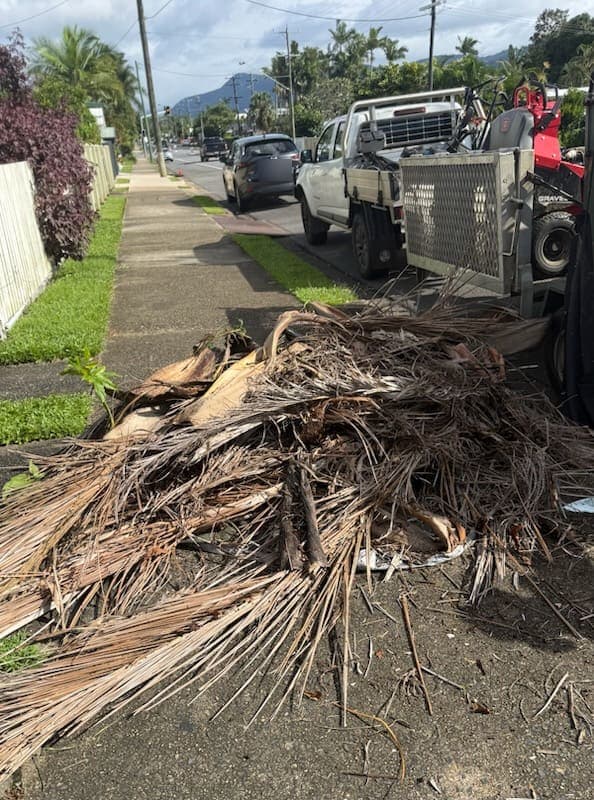
Once the branches are on the ground, the job becomes a clean-up. Trisim removes green waste across Cairns, covering palm fronds, prunings and storm debris cleared from the property rather than stacked at the kerb, and quotes the job before starting, disposal included. A photo of the pile is usually enough for a real figure. The cutting itself is for you or a qualified tree professional.
One thing to know when you compare quotes: council's normal disposal rates still apply to green waste a garden maintenance contractor brings in on a resident's behalf, even during a free period. See the green waste removal page for how it works.
Common questions from Cairns residents
Yes, as far as your boundary line. The common law right of abatement lets you remove the overhanging part yourself. You must comply with any vegetation protection order on the tree, and you should not trim where any part of the tree is in, or could fall into, the exclusion zone around power lines.
Under the Act, the tree-keeper is responsible for cutting and removing branches that overhang your land. If you give a Form 3 notice for branches that qualify and the work is not done within the time allowed, the tree-keeper is liable for your reasonable costs up to $300, recoverable through QCAT as a minor debt. That cost recovery only applies to work done after a Form 3 notice, not to branches you cut under the abatement right.
More than 2.5m above the ground. Section 57 of the Act limits a Form 3 notice to branches overhanging by at least 50cm, and only the parts 2.5m or less above the ground. The Queensland Government says that where branches are more than 2.5m above the ground and overhang by at least 0.5m, you can apply to QCAT for an order. Talking to the tree-keeper first matters, because QCAT looks for a reasonable effort to reach agreement.
Start by cutting the roots back to your boundary, which the abatement right allows, and talk to the neighbour. If damage has already happened or is likely, QCAT can hear a tree dispute and order compensation or repair costs, maintenance, or in the last resort removal. You can still apply for compensation even if the tree has since been removed, unless the tree-keeper has sold the land the tree was on since the damage was caused.
You are allowed to return them, but you do not have to. Queensland law says a neighbour who cuts overhanging branches may, but is not required to, give them back to the tree-keeper, and for work after a Form 3 notice it does not authorise entry to their land. Agreeing where the branches go, or disposing of them as green waste yourself, avoids starting a second argument.
Sometimes. The Australian Government's business licence listing says Cairns Regional Council approval is needed to clear or work near protected trees and vegetation on private property, and mangroves and other marine plants are protected under state law. A tree may be protected if it is large and significant, near a waterway, in bushland or of heritage value. Ask the council before cutting if you are unsure, and get the answer in writing.
Usually not. Normal leaves, flowers, fruit, seeds and small deadwood are not treated as substantial, so they are rarely enough for a QCAT order. A substantial and ongoing build-up of litter can be unreasonable interference, which QCAT can consider. Talking to the neighbour about trimming is the usual first step.
Sources
- Neighbourhood Disputes (Dividing Fences and Trees) Act 2011, Queensland Government (Queensland Legislation). Accessed .
- What to do if a neighbour's tree is affecting you, Queensland Government. Accessed .
- Overhanging branch disputes, Queensland Civil and Administrative Tribunal. Accessed .
- Tree disputes, Queensland Civil and Administrative Tribunal. Accessed .
- Step-by-step guide to resolving tree and fence disputes, Queensland Government. Accessed .
- About neighbourhood mediation, Queensland Government. Accessed .
- Planting and trimming vegetation, Electrical Safety Office (Queensland Government). Accessed .
- Tree and vegetation approval: Cairns Regional Council, Australian Business Licence and Information Service (Australian Government). Accessed .
Last reviewed by Trisim Property Maintenance. Rules and council services change, so check the source before you rely on a date or a fee.
Related services
Lawn mowing around Cairns
From the Knowledgebase
- Free green waste in Cairns: dates, transfer stations and when to pay for removalThe next free green waste dates in Cairns, the four transfer stations and hours, what they accept, 2026/27 tip fees, and when paying for removal is easier.Read the article
- Pre-wet-season yard and gutter checklist for CairnsA pre-wet-season yard checklist for Cairns before cyclone season: gutters, green waste, branches, loose items, rental roles and the after-storm clean-up.Read the article
- Who looks after the lawn and garden in a Queensland rental?Who mows, weeds, prunes and clears gutters in a Queensland rental? The RTA rules for tenants and owners, item by item, with the Cairns wet season in mind.Read the article
Branches down? Get the green waste taken away
Prunings, palm fronds and storm debris removed across Cairns, quoted before any work starts.